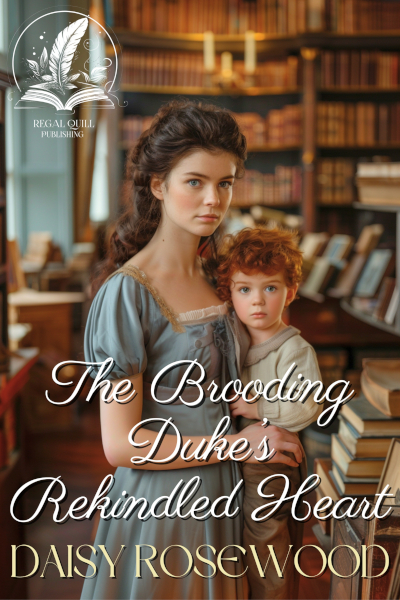
Chapter One
Clara Wentworth, widowed for two years and still grieving, paused in the doorway, uncertain whether to interrupt the quiet occupation before her. Henry was kneeling on the rug, his small brow furrowed in a seriousness quite out of keeping with his years, while his wooden soldiers stood in two immaculate lines at attention. Each figure was inspected, shifted a fraction of an inch, and then left in its post as though the fate of nations depended upon such precision.
It was an exercise that her late husband, Captain Thomas Wentworth, had once delighted in, laughing at the seriousness with which his son attended to the “discipline of the ranks.” It was, Clara was certain, the same seriousness with which Thomas himself had addressed his own soldiers.
“Goodness, I miss you, Thomas,” she muttered under her breath, as she did several times a day.
Their brave and trusting son resembled his late father. His eyes were the color of emeralds, his hair a shade darker than the red of his father’s. They both held themselves with an honor and truth that surely a boy of merely five years was too young to understand.
Clara’s heart contracted at the sight. It seemed an injustice that Henry should be pressed into keeping alive a memory that the world had declared shameful. Society might call Thomas a coward, a traitor, but Henry, in his solemn mimicry, could not be persuaded of any such thing. He wished only to march his father’s little army to glory.
Clara rested a hand upon the doorframe, steadying herself. She had become well practiced in steadiness. In the years since her husband’s disgrace, she had discovered that composure was not merely a virtue, but a necessity. One did not weep when one’s child was watching, and one did not indulge in hopeless fancies when the next meal depended upon stretching a dwindling purse.
Yet, despite all her efforts, there were traitorous moments when she remembered what it had felt like to be chosen, cherished, and loved. She told herself those days were over. Indeed, she had almost convinced herself that the capacity had been buried alongside Thomas, until some flicker of hope would rise within her, reminding her that even the hardest winter must one day give way to spring.
A shrill clatter from the little army brought her back. One soldier had fallen, struck down by an overzealous maneuver of its comrades. Henry tutted with his father’s very intonation and set the figure upright again with all the seriousness of a commanding officer correcting a regiment.
Then, at last, he looked up at her. His smile was quick and proud, and for one piercing moment, the likeness to Thomas was so strong that Clara could not breathe.
“See, Mama,” he said, his voice trembling with triumph, “Papa’s men are ready.”
Clara managed to smile in return, though her throat ached. “Yes, my sweet boy. Quite ready indeed.”
A sharp knock rattled the door, followed by an even sharper voice. Clara stiffened. Few people called upon her these days, and fewer still with kindness. She gathered her composure, smoothed the front of her gown and opened the door to find George Wentworth glowering on the threshold.
She held her breath, suspecting she already knew his reasons for calling. It had been a long time in the coming.
“Still here, then,” he said, his lips twisting in an ugly, thin line. He had none of his brother’s good looks and even less of Thomas’s charm, but he was now, Clara supposed, the proprietor of what had once been their home.
“George,” she replied with a cool nod.
“I should have thought even you might recognize when a place is no longer yours.”
Clara’s fingers tightened around the doorknob, but she forced herself to stand tall. George was narrow in both frame and spirit, and his pale eyes slid over her as though she were no more than an intruder. He was so easily swayed by the ton’s opinions. She knew he would come after her eventually. After all, she was nothing but a traitor’s widow.
“You will take the boy and go at once,” he continued, his voice cutting through the small hallway. “My wife will not tolerate your presence here another day. Nor will I. My brother’s disgrace is stain enough upon this family; we need not parade it under our own roof. You have surely heard what the neighbors are saying. I will not be tarred with the same brush.”
At the word disgrace, Clara felt the familiar tightening in her chest. She drew a breath. “Thomas was no coward,” she said quietly, though her voice shook. “You know as well as I do that he was loyal to the last. He would never have—”
George’s laugh was bitter. “Never? He was tried before a court-martial, Clara. He was convicted and found guilty. That is not the loyalty of which you speak. It is treason.”
“It was a mistake,” she insisted, her hands trembling, though she held her chin high.
“A mistake?” George scoffed. “Remind me, Clara, how one mistakenly betrays one’s country?”
“Thomas was honor itself. He would never betray his country, nor his men. If you had stood by him … if any of you had, then you might have seen it.”
“Stood by him?” George’s pale eyes hardened. “You think me blind and deaf? I heard the same evidence as the rest. I tried, honestly, I did, to salvage some measure of decency from the wreck he made of himself. But the damage was too great. No family can recover from a scandal so black, and now you would have us suffer further by clinging here as though nothing has happened. I cannot allow it to continue. You and that boy of yours are no longer part of this family.”
“But …”
George gave a sharp sniff, reminding her that she had no place to speak. “See that you are gone before nightfall. I will not have the neighbors gossiping further about how I am harboring a traitor’s widow.”
Clara’s throat burned as she watched her brother-in-law glare at her, his decision made. She wanted to shout, to remind him that Thomas had been his brother, his blood, and that loyalty ought not be discarded with such coldness. But George’s expression had made plain the futility of such an argument.
She bowed her head and turned away. She had been expecting it every month since Thomas’s death, yet still it hurt. During the many years of Thomas’s military postings, Clara had learned to pack quickly. Then, each move had been filled with excitement and the promise of reunion. Now the same movements felt hollow and desperate, and there was no loving husband waiting at the journey’s end.
As she folded Henry’s few shirts, Clara told herself she would not cry. Her tears would serve no purpose here, except to give George the satisfaction of victory. He hovered in the doorway, arms folded, watching her as though to ensure she did not dare take more than what he allowed.
Henry, sensing the tension, pressed close to her side and whispered, “Must we go, Mama?”
“Yes, dearest,” she said softly, tucking a toy soldier into the trunk. “We must.”
She pressed her lips together, lifted the trunk lid with care, and closed it firmly. She had barely removed her hands when George’s manservant brushed against her, picking up the trunk with ease. She sighed and began packing a second. She wanted to take as much from their old life as possible.
The scrape of wood against stone drew Clara’s attention to the window. Her trunk was already being hauled into the street as though it were nothing more than rubbish to be discarded. Heat rose in her cheeks, though whether from humiliation or fury she could not tell. Most likely both.
With a sigh, she turned to resume her packing, but another carriage drew up before the house, pulling her attention back to the window. She glanced at George who, like her, was now staring down at the street. The carriage silenced even him, though the twist of his expression told her he was unhappy. Clara’s heart gave a small jolt of hope.
The door swung wide, and Beatrice Wentworth descended with all the authority of a general entering occupied territory. Age had made no dent on her figure, and her hair still bore the flash of red that was so synonymous with her family. Her green eyes, sharp and bright, missed nothing as they swept over the scene: trunks in the street, George standing smugly in the hall, and Clara frozen in the midst of packing.
“So,” she said, her voice cool as steel, “this is how you honor your brother’s memory.”
George colored, his lips thinning. “Mother, you cannot know the whole—”
“I know enough,” she cut in. “I know that your brother begged you to care for his wife and son should anything happen to him. And I know that instead of honoring his last request, you stand here casting them into the road as if they were dirt. Is that really how I brought you up to behave?”
Clara felt the force of those words strike George like blows. She had never dared speak of Thomas so openly, but Beatrice had no hesitation. She remained firm in her belief of his innocence.
George squared his shoulders. “You forget yourself. I am master here, and my wife will not abide the scandal any longer. Clara brings disgrace with her wherever she goes, and the rest of the family is beginning to feel the brunt of my brother’s—”
“Disgrace?” Beatrice’s eyes flashed. “The disgrace is not hers. It is ours. A disgrace that we allowed society’s whispers to outweigh our loyalty to Thomas. He was your brother.”
“My brother,” George said with a sneer, “was court-martialed for treason. He sold secrets to the French. Do you ask me to hold my head high in Bath while harboring his widow beneath my roof? Do you wish my children to suffer the same ridicule as Henry?”
At that, Clara drew in a sharp breath, but Beatrice reached out and gripped her hand, silencing her with its tightness.
“You think yourself so prudent,” Beatrice said, her voice trembling with indignation. “But prudence is no excuse for cowardice. Better to endure society’s sneers than to betray one’s own blood.”
George flushed a deeper red. “You speak of cowardice? I have endured two years of pitying glances and whispered gossip, all for Thomas’s sake. And this woman’s, who, may I remind you, is not of my blood.”
“But she is of your family, George, whether you like it or not.”
“The stain is too deep, Mother. If Clara had any consideration for the rest of us, she would have left long ago and all without my needing to command it.”
“Enough,” Beatrice snapped. “I will hear no more. If your pride matters more to you than your brother’s family, then so be it. They will come with me. I shall not leave them to your cruelty for even another hour.”
George faltered, caught between resentment and the remnants of filial obedience. His mouth worked as though he would speak again, but no words came. At last, with a mutter about ingratitude and impropriety, he turned on his heel and stalked away.
Beatrice exhaled sharply, then looked at Clara with softened eyes. “Come, my dear. We shall have no more of this. You and Henry will be with me, and together we shall cherish Thomas’s memory.”
Relief and shame mingled in Clara’s breast. To be rescued was a blessing, yet to be forced into rescue at all was a humiliation she could hardly bear. Still, when Beatrice stooped to embrace Henry and he clung to her with childlike trust, Clara could not withhold her gratitude.
Together, they stepped out into the sunlight, leaving George’s cold house behind them.
The journey to Bath was quiet for a long time. The carriage wheels rattled over the cobblestones, each jolt pressing Clara further into the worn leather seat as if they, too, wished to see her smaller. Beside her, Henry leaned against her arm, already drowsy with the motion, his little hand curled tight around one of his soldiers. Across from them, Beatrice sat upright, her chin lifted in that familiar, imperious way, but when her eyes rested on Clara, they softened to her usual kindness.
“You must not trouble yourself over George,” she said, laying a gloved hand over Clara’s. “He is a foolish man and always was. His notions of respectability are worth nothing when weighed against the duty he owed his brother. And he has been jealous of Thomas since they were babes. Even now, after Thomas’s death, it seems George cannot overcome his pettiness.”
Clara lowered her gaze. “Still, I do not like to be such a burden. It was not Thomas’s wish that I live by the charity of others.”
“It was not his wish to die and have his name dragged through the mud either.” Beatrice’s brows rose. “Besides, it’s not charity when a mother protects her son’s family. Do you think I would abandon you and Henry to that cold-hearted wretch? No, you belong with me, and that is an end of it.”
Clara’s throat tightened with gratitude, though she dared not speak it. The older woman’s fierce loyalty was both a balm and a weight upon her heart.
They traveled for a while in silence, save for the creak of wheels and Henry’s soft breathing. Clara’s mind was restless, and she began to count their meager savings in her head. They had enough, perhaps, for two months’ bread and rent, if she were careful. Henry’s boots would never last the winter, though, and that was another issue. She frowned and willed her worries into order when Beatrice spoke again, her voice quieter and more guarded.
“There is another matter I must tell you.” She glanced toward the window, as though expecting pursuit. “Lord Percival Hawke has been asking questions about you.”
Clara startled. “About me? Why should he?”
Beatrice’s mouth compressed. “Because he was no friend to Thomas. There are things that your husband feared would follow you, should he fall. He wrote to me before he died, warning me that danger might come disguised as protection. It is why I came at once when I heard the whispers.”
Clara’s fingers went cold. She had grown accustomed to scandal, to the weight of people’s stares, but this talk of danger set her heart beating uneasily.
“Then we are not safe?” she whispered.
“We are safer together,” Beatrice said firmly. “I shall give you employment in the bookshop. It is modest, but it will provide you with income and shelter, and, more importantly, it will give you a place of your own. There, you may find peace.”
The words soothed Clara, though unease lingered like a shadow. She gathered Henry closer, watching his small chest rise and fall in sleep. He was all that remained of Thomas, her hope, her responsibility, her future. Whatever danger threatened to harm them, she would not let it touch him.
When at last the carriage rumbled into the streets of Bath, Clara pressed her forehead to the glass. Relief washed over her at the thought of escape, yet with it came unease. Beatrice carried secrets she did not fully share, and Clara could not shake the feeling that their trials were only beginning.
Chapter Two
Edward Ravenshaw, Duke of Ravenswood, woke in a black mood that seeped into every corner of his Bath home. The servants, long accustomed to such mornings, moved about with hushed footsteps, as though the very floorboards might betray them. Edward’s legs throbbed with the familiar burn, each movement an effort, each adjustment of the sheets a reminder of war wounds that refused to be forgotten.
A knock on the door announced his valet. “Good morning, Your Grace.” The words were delivered with the careful cheer of a man who expected no reply and would not be surprised by a cutting one.
Edward gave none. He levered himself upright, grimacing at the pain that caught him mid-motion, and allowed the valet to bring in the tea tray.
“Two cups, as usual, Your Grace,” the man said, hesitating only a fraction before placing the second cup across the table.
Edward’s jaw tightened. The ritual was his own doing, yet it mocked him every day. He reached for the pot, poured with a steady hand, and sat down. Across from him, Catherine’s chair stood politely empty, as it had for five long years. So often, he forgot that she was gone, and then the realization struck with the cruelty of a fresh wound. He stared at the rising steam, his voice low and edged.
“Remove it.”
“Sir?”
“The second cup. Take it away.”
The valet obeyed swiftly, though his hands trembled against the porcelain. “Of course, Your Grace. At once.”
Edward lifted his own cup and drank alone. The silence weighed heavily, broken only by the tick of the mantel clock and the faint scuffle of servants beyond the door. His anger was not truly for the valet, nor even for the team, but for himself. For the weakness of habit. For remembering, when forgetting might have been kinder. Though he could never forget Catherine.
When the valet returned with the physician’s salves, Edward set his cup down with a deliberate click. The treatment was a necessity he endured, though miserably so. “Let’s get on with it.”
“Yes, Your Grace.” The man bent to his task, hands practiced and careful. The ointment stung, the bindings chafed, but Edward made no sound save for the occasional indrawn breath.
“Perhaps,” the valet ventured after a time, “a walk later in the Crescent might lift your spirits. The air is fine this morning, and Bath is filling with company for the Season. You would be much remarked upon, I daresay.”
Edward’s laugh was short and bitter. “Much remarked upon, indeed. A lame duke limping among the peacocks? I think not.”
The valet flushed and said no more. He finished his work in silence, and when at last Edward was dressed and presentable, the valet withdrew with evident relief.
Left alone, Edward settled once more into the familiar armor of coldness and routine. It was safer like that, for himself and for everyone who came near.
Once in his study, Edward lowered himself into the armchair by the desk, his legs stretched stiffly before him. He stared at the neat stack of correspondence waiting there. Estate accounts, tenant petitions, letters from distant relations. It all demanded his attention, yet none was deserving of it.
But it is the only thing that lets you forget, he reminded himself. Buried in work was the only moment his mind allowed him to think of something other than his loss.
Once, he and Catherine had shared these morning duties. She would sit across from him, her head bent prettily over the ledgers, making shrewd remarks about expenditures and smiling when she teased him for his meticulous calculations. She had been right, of course, and when her laughter had filled the study, the burden of ducal responsibility had not seemed so heavy. Now the words blurred before his eyes, lines of ink without meaning, because there was no one left to read them with him.
The valet returned, lingering as he so often did at the sideboard, dusting surfaces already spotless. Edward ignored him at first, until the faint shuffle of hesitation broke his concentration.
“If I may, Your Grace,” the man began, clearing his throat, “the town is quite lively for the Season. Assemblies, concerts, card parties, and the like. There is talk of a ball at the Upper Rooms within a fortnight. Might it not—”
“Might it not what?” Edward cut in, his voice edged with impatience. “Make me forget? Teach me to dance again upon ruined legs? Provide me with a wife to replace the one already in her grave? I thought I had already once refused your suggestion today, Hobson.”
The valet’s face flushed, his eyes darting away. “I … I only thought a diversion might lift your spirits. You have been most constant in your solitude, Your Grace. A change of company could–”
“Could what?” Edward demanded. “Restore what is gone? Make me whole? You speak as though society were a tonic, as though card tables and waltzes could cure grief or heal burns. You thought incorrectly.”
Hobson paled, bowing his head, a replay of his actions the day before and the day before that. “Forgive me, Your Grace. I meant no disrespect.”
Edward returned his gaze to the letters, dismissing the valet with a flick of his hand. “Attend to your duties and leave me to mine.”
A wounded silence followed. Hobson bowed himself out, the door clicking softly behind him.
Edward exhaled, pressing thumb and forefinger to his brow. He had not meant to be cruel, yet cruelty came so easily now. Every attempt at kindness felt like an intrusion, every suggestion of diversion a reminder of what he lacked. He looked again at the estate reports, but the words remained hollow, lifeless marks on the page.
The rap of knuckles upon the door a few hours later made him jump. He raised his tired eyes and called for them to enter. Hobson, grave as ever, ushered in the physician who had arrived for their regular check-up.
Dr. Rowley was a spare, brisk man with a neat wig and an air of authority that he wielded like another instrument. He carried a leather case in one hand and a folded report in the other, which he laid pointedly upon the duke’s desk.
“Your Grace,” he said with a bow. “I trust the pain has not worsened since my last visit?”
Edward inclined his head, neither confirming nor denying. “It has not improved.”
The physician made a sound between a cough and a sigh. “Then we must hope this new course of treatment will yield better results. I have consulted a colleague in London, a specialist in these kinds of injuries and their lasting effects. His recommendations are here.” He tapped the folded report with two fingers. “I advise you to read it at your leisure.”
Edward did not so much as glance at it. “Leisure,” he repeated, the word tasting bitter. “I find myself in possession of far too much of it.”
Undeterred, Dr. Rowley knelt to examine the leg, pressing and prodding places that made Edward wince. In a measure to control his reactions, Edward stared past him, his gaze fixed upon the window. Outside, the streets of Bath bustled with life: carriages rolling past, gentlemen doffing hats, children darting in and out of the sunshine. Laughter carried upward, sharp and acidic to Edward’s ears. He remembered a time when he had enjoyed that sound, when his own home had rung with children’s laughter. Not so much anymore.
“Your constitution is strong,” Rowley continued, prodding the scarred flesh gently. “There is no reason you may not regain more strength. In time, you may walk with less discomfort, even perhaps without the aid of a cane.”
Edward’s mouth tightened. “And if I do? Where should I walk that is worth the effort?”
Rowley paused, then glanced toward Hobson. “Your valet has suggested the Crescent, I believe. Fresh air, familiar company. He tells me you have refused.”
Edward’s eyes snapped from the window to the physician’s face. “So, the two of you confer about me now?”
Hobson, who had remained discreetly in the background, bowed his head without speaking.
The physician, however, did not falter. “We speak only out of concern, Your Grace. A man cannot live by pain and memory alone. If not the Crescent, then some other occupation must be found. Ashworth’s bookshop on Pulteney Street has lately received a shipment from the continent. I hear they have books on philosophy, poetry, and even the newest histories. You have always possessed scholarly tastes. And the movement will be good for your leg.”
Edward’s gaze moved to the report still lying unopened upon his desk. “Books,” he said flatly.
“Better than staring at walls,” Rowley replied, rewrapping the bandages. He rose, straightened his coat, and for the first time, his expression softened into something like pity. “Good day, Your Grace. Please do consider my suggestions.”
When the door closed behind the physician, Edward remained where he sat, listening to the echo of children’s laughter outside. Fever had taken Catherine and little William five years previously, leaving him with titles, lands, and nothing of what he truly valued. The physician’s words had scarcely touched him, yet the suggestion of books clung stubbornly in his mind and remained there for the entire morning.
Later that afternoon, and with great reluctance, Edward allowed Hobson to help him into his greatcoat and accompany him down Pulteney Street. He told himself he went only to silence the physician’s pestering, yet the mere effort of walking, each step jarring through his damaged legs, felt like penance.
Bath was a beautiful place. It had always been his favorite city, and yet its beauty made no impact on him now other than to remind him of how ugly his life had become. Families strolled arm in arm; ladies in bright pelisses laughed as they passed, their parasols tilting like blossoms. Edward kept his gaze fixed ahead, determined not to notice.
Ashworth’s bookshop stood at the corner, its windows lined with spines designed to intrigue. If Bath was Edward’s favorite city, then this bookshop was his favorite part of it. He remembered he and Catherine selecting children’s books when she was with child. They’d pawed over every single one before finally selecting William’s first library.
Edward approached, his breath tight with the dull effort of movement and memory as he reached for the door. He stopped, hand reaching out but not pushing. Through the glass, a scene unfolded that halted him as surely as if he had struck a wall.
At a small table by the window, a young woman sat with a boy upon her knee. Her dark hair, unpinned except for a simple ribbon, caught the sun. She leaned over an open volume, her lips moving in gentle cadence as she read, her violet eyes, so unusual, so beautiful, alight with quiet humor. The boy listened with rapt attention, a flash of red hair bent against her shoulder, his hand clutching hers as though the world depended upon it.
Something swift and unexpected pierced Edward’s armor. The easy intimacy of the pair, the unstudied grace of her hand as she turned each page, the child’s trustful closeness, all struck him with a force he had not felt in years.
He gripped his cane hard, fighting the rush in his chest. For five years, he had lived as though behind a glass pane, cold and untouched by the warmth of other lives. Yet here, in the span of a single moment, he could not stop himself from picturing Catherine, bent over William’s toys, a small head against his own shoulder as he watched.
His heart gave a thud so violent he thought it might undo him. He had believed himself long past such sensations, yet the sight of a stranger and her child made him remember what it was to feel alive, and it reminded him, cruelly, of how much he had lost.
He remained motionless on the pavement, staring through the glass at this beautiful woman and her beautiful child, unwilling to move closer and yet unable to look away.
Chapter Three
Clara closed the volume she had just finished reading aloud to Henry and squeezed him closer to her, grateful for his presence, even if he was too young to understand.
“That will do for now, my sweet boy,” she said, smoothing his hair. “The soldiers are eager for your command, I think, and I must see to the shelves.”
Henry accepted the change with surprising ease, scooping up two wooden figures from his pocket and marching them across the worn floorboards. His quiet play was a comfort; he had always adapted more quickly than she expected.
They had been in Bath scarcely a fortnight, yet already the rhythms of the bookshop were becoming familiar: the soft creak of the staircase, the scent of parchment and glue, the curious glances of customers who seemed to recognize Clara as someone not quite local but could not place her. Here, she could almost imagine herself as an ordinary widow, supporting her son respectably.
Almost.
Beatrice moved about the shop with a restlessness that did not match its gentle order, a relentlessness that Clara didn’t recognize. She straightened already tidy piles, glanced at the ledger, then crossed to the window again, her gloved hand resting upon the sill as she peered out. Clara, shelving a set of volumes, watched her uneasily.
“Is something amiss?” she asked eventually.
Beatrice turned, her expression composed, though her eyes betrayed unease. “Not amiss, precisely. But I must tell you.” She paused, glancing again toward the street as if the danger were imminent. “I will soon have to leave Bath for a time and travel to France.”
Clara set the books down carefully, straightened, and looked at her mother-in-law curiously. “France?”
“There are papers,” Beatrice said, her voice low as she hurried closer to Clara, as if the walls had ears. “Documents that may yet prove Thomas’s innocence. I should have gone sooner, but I could not leave you until I knew you were settled.”
The words settled on Clara’s chest. She thought of the fortnight spent under Beatrice’s protection and the older woman’s authority shielding her from curious questions. Without her, Clara felt suddenly small and exposed, and all her worries came tumbling back.
“You will manage,” Beatrice said firmly, reading her silence. “You are stronger than you believe, and I have friends who will look out for you. But there is one thing I must impress upon you.” She stepped closer, her gaze intent. “Thomas’s final letter warned of danger.”
“Yes, but—”
“But I only wish to remind you that it may come to you cloaked in the guise of help, smiling where it means to wound. Trust no one completely, Clara. Not even those who seem most willing to assist.”
Clara’s stomach clenched. She thought of the polite customers who passed through the shop and of the neighbors’ friendly greetings. How many masks might conceal ill intent? “I … I don’t know if I can do this alone.”
Beatrice’s hand softened upon her arm. Her voice, when it came again, was gentler. “My dear girl, you will not be alone. You have Henry, and he is a brave little soul. You have this shop, which will give you purpose and respectability. And you have me, even when I am across the sea. You are my family now, as surely as if you had been my daughter from birth. Nothing will change that.”
Clara blinked quickly, refusing the tears that threatened. “You are too kind to me.”
“It is not kindness,” Beatrice said, squeezing her hand. “It is loyalty. And love.”
Henry laughed softly as his toy soldiers clattered together, and Clara forced herself to draw strength from that small sound. Perhaps Beatrice was right. Perhaps she was not as fragile as she feared. Still, the thought of the shop without Beatrice’s steady presence made her heart heavy.
Beatrice’s hand lingered warmly on Clara’s arm. “Remember what I told you,” she said softly. “Caution and courage both, in equal measure. I really must go if we have any hope of clearing Thomas’s name, but we have a couple of days, at least.”
Clara nodded. “I understand.”
“Now, I need to pop out for a bit. You will be all right with the shop?”
“Of course,” Clara said, managing a weak smile.
Beatrice gave her hand a final squeeze, then gathered her reticule and swept from the shop, the little bell jingling as the door closed behind her.
The sudden quiet felt strange. Clara pressed her palm to the counter, steadying herself. She hadn’t been expecting to be left alone, and certainly not so soon after their arrival. Henry hummed quietly on the floor with his soldiers, unaware of the hollow space left by his grandmother’s absence, and she looked over at him fondly.
She jumped when the bell on the door jangled again, sharper this time, and a tall gentleman stepped across the threshold. Clara turned and froze.
He was a striking figure, his height and breadth lending him a presence that made the shop’s modest walls seem too narrow. Dark hair, touched lightly with gray at the temples, framed a face both stern and arresting: high cheekbones, a straight nose, and eyes so deep and searching she felt them probing into her. He carried himself with an authority that required no announcement, though the faint stiffness in his gait and the way he leaned heavily on a cane spoke of old injury.
Clara’s breath caught before she could prevent it. She hated the sudden warmth that rose to her cheeks, hated more the traitorous flutter in her chest. It had been years since her body had answered so instinctively to the sight of a man, and even longer since it reacted to a man who was not her husband.
It is only surprise, she told herself. He merely reminds me, in some indefinable way, of Thomas.
And yet, despite all she silently willed upon herself, she could not look away. He had somehow enraptured her.
The gentleman removed his hat with learned courtesy. “Good afternoon. I am Edward Ravenshaw.” His voice was low, resonant, and carried the unyielding cadence of command, yet the way he looked at her was as if she were the one worthy of reverence. As if she, perhaps, were a ghost.
“Duke of Ravenswood,” he continued.
A duke!
Clara’s pulse skittered. Nobility meant power, and power meant danger. She could not, would not, expose Henry to further risk, especially not after Beatrice’s warning. Instinct overrode hesitation, and she dipped a curtsy.
“Mrs … Whitmore,” she said evenly, the false name slipping as easily from her lips as if she had always borne it. Years of disgrace had taught her the necessity of such evasions. To survive, one learned quickly which truths to bury.
“Whitmore,” he repeated slowly, his gaze fixed intently upon her face. The syllables seemed to linger in his mouth, as though he were testing them for honesty or tasting them for sweetness. Clara resisted the urge to shift beneath his scrutiny, forcing her features into calm composure, though her throat tightened.
She summoned a polite smile. “How may I assist you, Your Grace?”
The duke didn’t answer at once, and Clara shifted her weight from foot to foot, uncomfortable in his silence. His gaze swept the shop, taking in the neat rows of volumes and glancing over Henry playing in the corner. At last, his eyes returned to hers, and she felt pinned beneath them, as if he had the power to prevent her moving with his eyes alone.
“I am in search of military histories,” he said eventually, his voice low and deliberate. “Something comprehensive. Not the shallow pamphlets that pass for scholarship these days.”
Clara inclined her head, relieved to have a task, though immediately worried she would not be able to satisfy his particular tastes. “Of course, Your Grace. We keep such works toward the back wall, if you will follow me.”
She led him between the shelves, her palms brushing against her skirts to steady them. His step was measured despite the injury, and the faint tap of his cane marked his progress. The sound caught her, stirring a pang of sympathy she had not expected.
Clara ran her fingers lightly across the bindings, selecting a weighty volume and laying it gently before him.
She hesitated, her thumb resting against the embossed lettering. “These are popular,” she said. “Full of strategy, dates, and lines on maps.”
The duke seemed to gaze at her for a long moment and then said, “I find that many of these volumes give great detail about strategy itself, but they leave out far too much. The widows, the children, what’s left of our decimated world. It is a cost that never finds its way to the page.”
Clara’s head lifted sharply, surprise finding its way into her heart. “Most people do not see that,” she said at last, allowing his words to warm her. “You are quite right. Perhaps, then, something else is better suited.”
She led him further into the back of the shop, where she reached for a leather-bound volume. “This one is often requested. It’s a history of Wellington’s campaigns, thorough but not overly dense.”
She turned, holding it out, and for the briefest instant, their fingers touched. His hand was large, steady, and warm, the kind of hand that spoke of strength even in stillness. The brush of skin against skin jolted her as though the air itself had cracked, and she had the oddest sensation that she knew him already. Knew that he had been through so much and only needed someone to look after him. She pulled back at once, her breath quick, but the memory lingered in her fingertips as if they were silently willing her to return them.
The duke looked down at the book, his face composed, though Clara saw the way his jaw sat tightly and noted the pause he took before he spoke. “And others?” His tone was even, but not unaffected.
Clara reached again for the shelf, determined to keep her composure. “There are personal accounts of officers who served in the Peninsula. My husband always thought them valuable.”
The words slipped out before she could stop them. At once, his head lifted, his dark eyes fixing upon her with piercing clarity. “Your husband was in the military?”
She cleared her throat and nodded quickly. “Yes. Captain Went—” The name caught, and she forced it down with an effort. “Whitmore,” she finished, her lips dry.
For a moment, silence embraced them. The duke’s expression changed, as if a wall had come down between them, all warmth carefully locked away. His broad shoulders, which had seemed less forbidding when he first entered, squared again into formality.
“I see.” The words were quiet, but they rang with an echo of grief that was not hers alone.
Clara’s heart leaped at the sound. Something in his voice, in that deep, steady cadence, reminded her unbearably of Thomas and his calm authority, of the way he had steadied men in the field and steadied her in the chaos of military life. But instead of aching as it should have, her pulse betrayed her, quickening with a flutter that felt dangerously close to longing. She despised herself for it. To feel anything in the presence of another man, when Thomas’s memory was not yet cold in the world’s eyes, seemed disloyal and unforgivable.
Still, her gaze lifted of its own accord, and she studied the duke’s features again, intrigued now that she could see something more than presence within him. The lines of his jaw were strong, and his deep-set eyes were shadowed by loss. Something seemed oddly familiar in him, though she could not say why.
“Forgive me, Your Grace,” she said softly, compelled by something inside her, “but have we met before?”
His eyes held hers for a long, unreadable moment. Then he said, clipped and firm, “No.” The word was sharp and final, yet behind it she thought she glimpsed a flicker of recognition or longing, or perhaps both. Perhaps it was merely grief meeting grief.
Clara lowered her gaze quickly, her heart thudding in her chest, as though she had trespassed upon a grief she had no right to touch.
“Mama.”
Henry’s voice jolted Clara out of her reverie, and she startled when he tugged her skirts. She looked down at him at her side, toy soldier forgotten in his hand, his wide eyes fixed on the window. “Mama, look.”
She followed his pointing finger. Across the street, half-shrouded by the shadow of a doorway, a man stood very still. His coat was dark, his hat pulled low, but there was no mistaking the direction of his gaze. He was watching the shop. Watching them.
A chill danced down Clara’s spine.
“How long has he been there, Henry?” she asked, unable to pull her eyes from the man.
Henry shrugged. “A long time, I think.”
She thought back to all the times they’d been followed, threatened, or merely jibed at thanks to Thomas’s supposed treachery. And then she thought of Beatrice’s warning that day in the carriage—that Lord Percival Hawke had been asking after her. And now, here was this man, intimidating in his look and watching them from the shadows for goodness knew how long.
For two weeks, she had told herself Bath was a refuge, that here she and Henry could vanish into anonymity. Even that very morning, she had convinced herself that Beatrice was worrying for nothing. Yet the sight of that motionless figure unraveled the fragile illusion she had built for herself.
Before she could speak, the duke moved. The shift was startling in its swiftness. His whole frame snapped into the alert stillness of a soldier scenting danger, and she knew in an instant that he, too, once fought in the military. It was probably where he had been injured. He crossed the floor in three firm strides, his cane striking sharply against the boards, and positioned himself beside the window.
“Keep back,” he commanded, his voice quiet but commanding. His gaze swept the street in a way that left no doubt he had done so a thousand times before.
Clara’s heart hammered. She grasped Henry’s shoulders and drew him close, torn between obedience to the duke’s command and the desperate urge to bolt the door herself.
The man outside remained only a moment longer and then, as though sensing he had been marked, he turned abruptly and melted into the passing crowd. The swirl of carriages and bonnets swallowed him, leaving nothing but the echo of his presence behind.
“Lock the door,” the duke said, not turning from the glass.
Clara obeyed with trembling hands, the key rattling against the brass before it caught. She pressed her palm against the wood, steadying herself, listening to the hollow thud of her own pulse.
When she dared glance back, the duke was still at the window, his expression carved in grim lines. “He was watching,” he said simply.
“Yes,” Clara whispered, clutching Henry to her side. Her son’s small fingers curled into her gown. The unease that had lingered since Beatrice’s warning now flared into sharp certainty. They were not safe.
“Do you know who he was?” the duke asked.
Clara shook her head firmly, her lips pressed together as she refused to show her emotion.
He stared at her for a long moment, as if weighing up a decision. Finally, he nodded. “Very well. Lock the door behind me. I advise you to remain closed for the rest of the day.”
Hello my dears, I hope you enjoyed the preview, and very soon the book! I will be waiting for your comments here. Thank you 🙂